Negative feedback
The Selfish GeneNegative feedback is a control principle in which a system detects a difference between its current condition and a target condition, then acts to reduce that difference. In the book, it explains how a machine can behave as if it were pursuing a purpose without consciously desiring anything—a distinction that also helps clarify how genes influence behavior indirectly, through the systems they build.
The control principle
A purpose machine is equipped with a measuring device that registers the discrepancy between its present state and its desired state. The greater the discrepancy, the harder the machine works to reduce it. As the discrepancy narrows, the corrective action diminishes; if the target state is reached, the machine may come to rest. The feedback is called negative because the system’s response opposes the deviation rather than amplifying it.
The principle gives a precise mechanical account of apparent purposiveness. A machine’s goal is not necessarily something it consciously wants: it is the state to which the system tends to return. This separates observable, goal-directed performance from any claim about consciousness, leaving open whether an animal that searches for food or a lost young experiences purpose as humans do.
The Watt governor
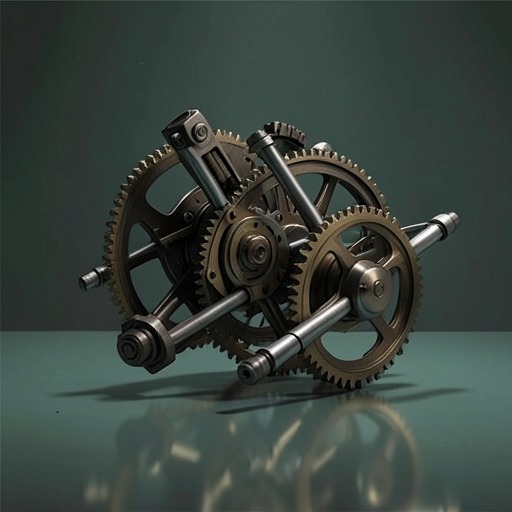
The Watt steam governor makes the mechanism concrete. A steam engine spins two balls mounted at the ends of hinged arms. As the balls rotate faster, centrifugal force pushes the arms toward a horizontal position, while gravity resists their movement. The arms connect to the engine’s steam valve: as they approach horizontal, the valve shuts off some steam, slowing the engine. If the engine slows too much, the valve feeds it more steam, and its speed rises again. The system therefore counters departures from its target speed through a continuing adjustment of the steam supply.
Correction is not always smooth. A machine may overshoot its target and oscillate because of delays in its response. Engineers can add supplementary devices to reduce these oscillations. The governor thus illustrates both the basic feedback loop and a practical complication: the timing and strength of correction affect how steadily the system returns toward its target.
From machines to living behavior
The book extends the analogy beyond the governor. Guided missiles can appear to search for and pursue a target, adjusting to evasive movements and sometimes seeming to anticipate them. Their behavior can be explained through negative feedback, feed-forward, and other engineering principles without supposing that the missile is conscious. The apparent deliberateness belongs to the system’s operation, not necessarily to a mind directing it at every moment.
Living bodies also make extensive use of principles familiar from engineering. The analogy is relevant because genes do not issue moment-by-moment instructions for every action. They influence behavior indirectly by shaping survival machines and their nervous systems; the nervous system handles immediate decisions. In this formulation, genes are the primary policy-makers and brains the executives. Learning and simulation allow brains to take on more of the practical decision-making, while the evolutionary account still concerns the differential survival of genes in a gene pool.
Explanatory reach and limits
Negative feedback helps make sense of behavior that seems purposive without settling the philosophical question of consciousness. The book uses the distinction to resist a related misconception: a machine does not need to be under the immediate control of its original designer simply because a conscious human built it. Likewise, genes can exert powerful ultimate influence without dictating every action directly. Their effects run through the development of the machinery that responds to circumstances.
The principle is therefore both a mechanical explanation and a conceptual bridge. It shows how systems can correct deviations and behave as if directed toward an end, while keeping separate the system’s observable operation, the question of conscious experience, and the evolutionary history that explains why living control systems exist.